When it broadens your understanding
Learning with generative AI

When it broadens your understanding
Learning with generative AI
Outsourcing or partnership?
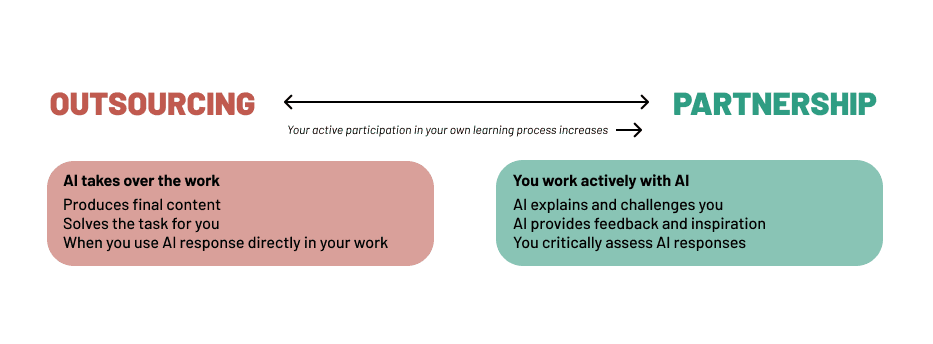
When working with generative AI in learning processes, it can be helpful to distinguish between the concepts of outsourcing and partnership.
Outsourcing: When thinking is handed over to technology
You delegate the task or the production of content to AI, for example by copying an AI-generated response directly into your work without processing it yourself or engaging with it critically. In this situation, the active cognitive engagement that is essential for learning does not take place.
Partnership: When AI becomes part of the learning process
You use AI as a cognitive sparring partner that supports your reflection, analysis, and problem-solving. AI can be used to explain complex concepts, facilitate idea development, provide formative feedback, or suggest improvements to your drafts and working documents. You retain academic ownership and continue to work actively with the material generated by the tool.
The crucial question is not how much AI you use, but how much of the thinking you continue to do yourself. The same tools can both support and undermine learning. When AI takes over analysis, evaluation, and academic decision-making, there is a risk of cognitive offloading. When AI is used to challenge, develop, and refine your own thinking, the technology can function as a learning partner.
The boundary between outsourcing and partnership is therefore rarely clear-cut. What matters is not the tool itself, but whether you retain intellectual and academic ownership of the work. The two approaches are best understood as opposite ends of a continuum, where the degree of your own academic engagement and cognitive effort determines where your practice falls between the two concepts.
Are you ready to learn?
The quiz below introduces you to a number of cases that serve to exemplify the differences between oursourcing and partnership. See if you can guess which is which.
Learning with generative AI and Bloom's taxonomi
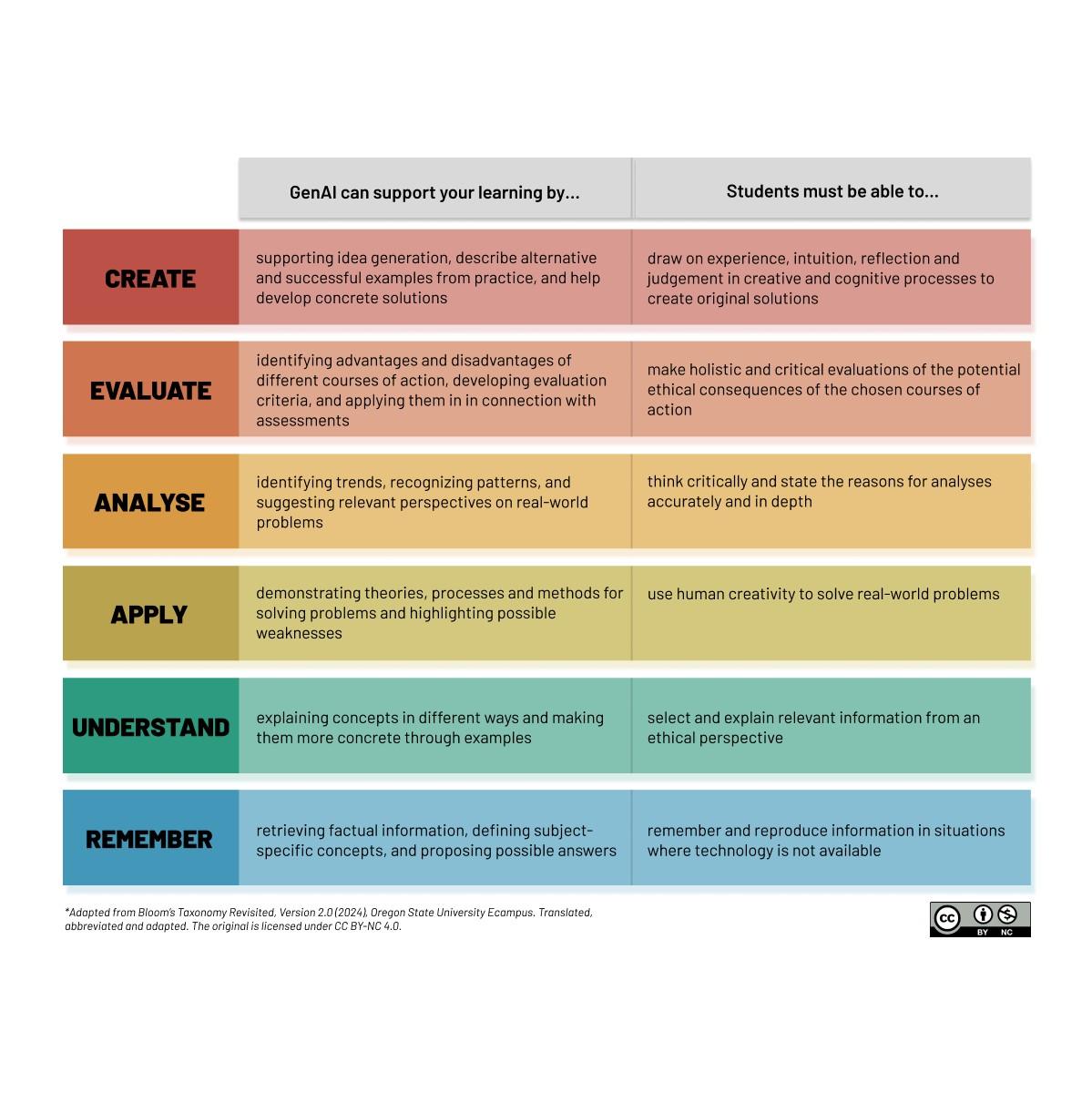
Oregon State University has developed a model which specifically focuses on the use of generative AI in learning processes. The model is based on Bloom’s Taxonomy and its progression from remembering and understanding to applying, analysing, evaluating and creating, but reinterprets these stages within an AI context.
In addition to the traditional cognitive levels, the model also incorporates human–technology collaboration, including ethics, process reflection, academic integrity, and the critical evaluation of AI-generated content. In this way, the perspective is broadened from what is learned to how learning takes place and the responsibilities involved in working with AI.
Below is a modified version of the model developed by Oregon State University:
What can I do myself?
Based on the model above, there are several practical steps you can adopt or draw inspiration from to help move your study practice away from outsourcing learning and towards forming a genuine partnership with generative AI.
When you are acquiring new knowledge (REMEMBER and UNDERSTAND)
Test yourself without assistance: Close the chat after using AI to explain a difficult concept or provide examples. Explain the concept aloud to yourself or write a short bullet-point summary by hand without using any aids. If you cannot do so, it is only the AI that has “understood” the concept, not you.
Ask for alternative analogies and examples: Tell the model to explain the same academic phenomenon through two very different metaphors or practical examples. Then decide for yourself which explanation is the most accurate and useful.
When you are processing information and solving problems (APPLY and ANALYSE)
Demand academic grounds for identified patterns: If AI identifies a pattern or a methodological weakness in your material, always ask it to elaborate, e.g.: "Which methodological criteria underpin that assessment, and which conflicting data in my material have been disregarded in reaching this conclusion?”
Tie AI-generated patterns to reality: Allow AI to identify trends in raw data or theoretical material, but formulate the conclusions yourself by linking them directly to your specific empirical evidence and its context.
When you are assessing and creating new knowledge (EVALUATE and CREATE)
Use AI as an ethical devil's advocate: Ask the model to present the most compelling advantages and disadvantages of a proposed solution. Then use your own academic judgement to assess the ethical implications and develop your own solution.
Use AI for variation, but create the synthesis yourself: Make a brainstorm where you use AI to generate ten unconventional perspectives or alternative structures. Be critical in your assessment, selection, and revision of the responses, and write it into somthing original.
Choose the partnership
Generative AI does not change the fundamental nature of learning - i.e. a process where you develop your own knowledge, understanding, and professional judgement. The technology can support your learning, but it cannot learn on your behalf. When you use it as a partner, rather than a shortcut, you strengthen the quality of your final work, as well as your academic development. This is where AI becomes a tool for learning rather than a subsitute.
Questions for you and your project group
Personal study practice and cognitive ownership
- Think of an assignment or study activity from the past week in which you used generative AI. Where on the spectrum between outsourcing and partnership did your process actually lie, and what did this mean for your own learning and academic development?
- In which situations do you find it most tempting to outsource the work, and what do you lose academically by delegating the task to AI rather than using it as a discussion partner?
- Take a look at the six levels in the model from Oregon State University. Which levels (for example, REMEMBER/UNDERSTAND versus ANALYSE/CREATE) do you use AI for most often, and how do you ensure that you can still master the subject matter without relying on technology?
- When you use AI at the EVALUATION level (in the taxonomy), how do you ensure that the model's ethical suggestions are not simply reflecting a standardised majority view?
Collaboration, boundaries and shared learning
- Where would you (the group) draw the line between legitimate "cognitive partnership" and acutal outsourcing of your learning process? How do you ensure that all group members understand and are able to account for the contents of the project?
- If AI disappeared tomorrow, would each of you still be able to explain, justify, and defend the work you have produced?
- If we use generative AI for e.g. idea generation or analysis, how do we share the responsibility for actively contributing with our own judgement, intuition, and ethical reasoning?
- Find a specific example of a prompt and response that you have generated for your project. Discuss it step by step: How exactly did AI contribute? How exactly did you contribute yourselves? How did your own understanding develop during the process?